
In the late 1800s Finley (Fin) Barkley, a railroad man from Tehama, CA, came to southwest Arizona to homestead. He claimed 160 acres in a spot on the Colorado River, about 20 miles northeast of Yuma, AZ. Consequently, when the Laguna Dam was built in 1903-1907 and Mittry Lake was formed, the homesteads that were flooded, including Fin’s, were moved to Southern Yuma County, in the Yuma Valley.
In 1918, Fin’s nephew, Les Barkley moved from Red Bluff, California, being a Merchant Marine, to the prosperous farming valley of Yuma, Arizona. There, he joined his uncle Hugh Barkley who had was homesteading in the area since 1912. For years, the two farmed in the Yuma Valley, producing cotton and alfalfa.
Eventually Hugh left the Yuma Valley to return to Northern California. Les became a successful farmer and cattle rancher. In 1929, the Stock Market Crash and the Great Depression started what would be a tough time for farming. During the Great Depression, Les started buying foreclosed and tax delinquent properties. One of his favorite sayings was “Save your money and jingle your rocks, and you’ll always have tobaccy in your ol’ tobaccy box.” Meaning don’t show off your money, save it and you’ll always be able to have what you want and need. He’d saved during his youth and was able to purchase a good amount of land as it became available throughout the years.
Les and Floy had two children, James (Jim) Finley Barkley, born in 1925, and Mary Martha Barkley, born in 1928. They raised them first in Somerton, and then in a farmhouse in the south end of the Yuma Valley, close to Gadsden. Both of their children attended Gadsden Elementary School and then Yuma Union High School. While Les mainly farmed alfalfa, wheat, maize and cotton, he also raised cattle and sheep. There was a bunk house behind the small farmhouse where they lived where itinerant cowboys would live while they helped work the herd. The small cattle feed yard on that farm would eventually give on to a very large cattle operation that lasted until the 1960’s.
By 1943, Jim Barkley- Les’s only son- was graduating from high school and preparing to join the country’s war efforts.
Farming during World War II brought many challenges. A shortage of men on the farm led to the development of the Braceros- contract laborers from Mexico who assisted with farming operations here in the United States. As a result of labor shortages during this time, many women, including Jim’s wife-to-be Louise, joined in the effort on the family farm and helped out where needed. After a 3-year tour of duty in the Navy, Jim Barkley returned to the Yuma Valley and took over the family farming operation from his father while Louise continued to teach at Yuma Union High School until the birth of her daughter, Mary. Eventually Jim and Louise had two more children, Jim Jr., and Robert (Robby).
Jim got his pilot’s license, and then he set out to learn all he could about scientific farming. He was one of the first farmers in Yuma to start to grow winter produce such as iceberg lettuce, broccoli, cauliflower, and green onions. He was especially proud of his cotton, though, and in a time before green cultivation was an issue, learned to grow, with the help of Gabe Piceno, 4 bales per acre cotton. This was in a time when the southern United States was struggling to produce 1 bale per acre. The Colorado River Basin was rich with silt from the river floods and relatively undamaged by over farming. Jim learned about NH3, ammonia, a necessary nutrient to grow lush crops, as well as other chemical and organic fertilizers and pesticides. This new kind of farming became the basis for agriculture across the US and made it possible to help end soil depletion, and food and fiber shortages that had plagued farmers. He was one of many pioneers in agriculture whose dedication we all owe so much gratitude towards.
Jim also used his mechanical engineering skills to invent many useful machines in his shop. He worked to improve planters, applicators and harvesters. His work in mechanical cultivators- machines that could weed and thin cotton- helped to mechanize cotton farming and reduce the toil of workers in the fields. As the years passed, farming became more specialized and mechanized. Almost all harvesting became mechanized, and cultivation became modern. The farm started to grow in acreage, as JFB expanded the business. He bought other farms and expanded into California and Mexico. In 1971, he formed Barkley Seed, which exists today as part of Barkley Ag.
Soon Jim and Louise’s kids grew up. Eventually Mary married John Auza, from another pioneer family, and moved to Wellton-Mohawk valley where they raised sheep and had three children, Hank, Caroline and Chris Auza. Jim Jr. joined the Marine Corps after his time in U of A, where he was a lieutenant and travelled to several places. He then went to UC Davis and received his master’s degree in business admin. When Robby finished up at NAU he headed back to Yuma where he began to work on the farm with our father.
In August of 1979, when Jim was 52 years old, he was flying a plane that was his dream plane, a P51 Mustang World War II fighter plane. He headed to Oxnard, where he had a farming operation. When he didn’t show up at the scheduled time, it was feared that he had crashed. One of the largest aviation searches in the history of the southwest ensued, and his plane and body were discovered in the foothills west of Palm Springs. The tragedy was devastating to the family and to many in the community. His funeral service was attended by nearly a thousand people, and his memory is still alive for so many people. One thing that always is said of him is that he was a person of huge intelligence and charisma and that no one ever heard him say so much as the mildest of curse words. He was surely one of a kind.
During this time, Robby married a beautiful young Marine widow, Kathy Conard Jones. She had three great kids, Tim, Kelly, and Toby Jones, who became part of the family. A couple of years later, Robby and Kathy had a child together, Michael Barkley, and their family was complete. They were married for many years. Sadly, Kathy succumbed to lymphoma in 2003. She has a great legacy in her children and her talent as an artist.
Barkley Company had some hard years ahead, but with some incredible perseverance, probably born from a history of perseverance in the family, Barkley Company prospered and became strong once again. Robby continues as the head of the company. Hank Auza is the grower and farm manager, Toby Jones runs international shipping and the real estate division, Chris Auza is the harvest manager, and Michael Barkley has a greenhouse business and olive tree groves.
Robby met and married a sweet and very pretty young woman, Rachael Ruben Byrd. She has a daughter, Sammy Byrd. Mary lives in Yuma and Jim lives in San Rafael, CA. Sadly, Louise passed away a few years ago.
Her grandchildren have done well. Hank married Cori Allen, the daughter of a Wellton-Mohawk farming family, and they have two daughters, Harleigh and Zoey, who now work for the farm, and one son, Hank, Jr. Tim married Evelyn Snell, and they live in Los Angeles, with two children, Tessa and Finley. Caroline has two children; Hayden and Hannah May and they live in Phoenix. Kelly married Dr. Andy Meyer; and has four children, Brynkley, Zander, Haven and Anwyn and live in Boulder, Co. Toby married Jenny Hardy, whose family has a long history in Yuma, and have four daughters; Jordan, Olivia, Ella and Claire. Chris and his wife Sam have 4 children; JR, Annie, Caroline and Barkley. Michael lives in Yuma and is young and still single!
Farming has evolved for the Barkley Family. The farm still produces wheat, cotton and produce, plus, a huge variety of winter vegetables, such as leaf lettuce, spinach and celery, as the market calls for them. We are excited to see how Barkley Company and the Barkley family evolve with each new generation in Yuma!
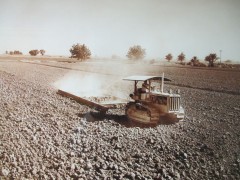
Circa 1948, on Les Barkley’s farm in Somerton, Arizona. A Caterpillar D4 diesel tractor pulls a wooden float to prepare fields for lettuce planting. As the float moves across the field, it carries loose soil into low areas, helping create a level surface, which improves irrigation efficiency and helps conserve water, an important farming practice that remains important today.
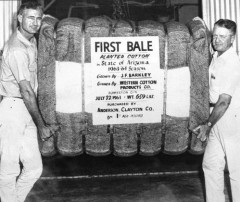
The Very First Bale from the first crop of cotton planted in Arizona during the 1963-64 season. Weighing 659 lbs. Grown by J.F. Barkley.
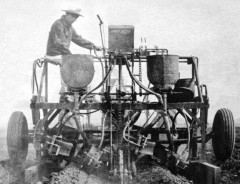
Circa 1974, this system, invented by Jim Barkley, created sidehill bed rows. Cotton was planted on the south side of the row in order to capture more warmth from the winter sun, protect germinating plants from the wind, and lengthen the available growing time for the cotton crop.
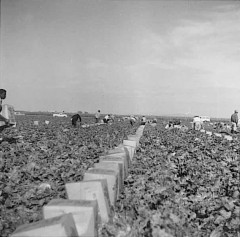
Iceberg lettuce packed by ground crews waiting to be loaded on flatbed trailers and transported back to the cooler where they will be vacuum cooled and shipped via truck.
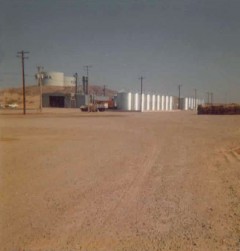
Circa 1970’s, the beginnings of Barkley Seed Incorporated’s mill and processing facility. The company’s seed operation and corporate headquarters are still located here today.
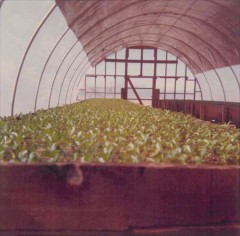
Circa 1970’s, transplanting is becoming increasingly important to the agriculture industry and Barkley Company was an early adopter to transplanting, as a way of utilizing resources in an efficient and sustainable way.
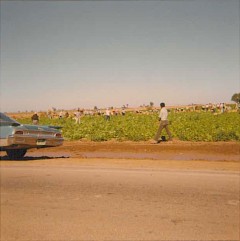
This photo shows iceberg lettuce being harvested by hand, before the harvesting machines were introduced in the late 1970s and early 1980s.